Reviews
Part of Product marketing strategy: the version that survives contact with reality
4 things a product marketing strategy checklist has to cover
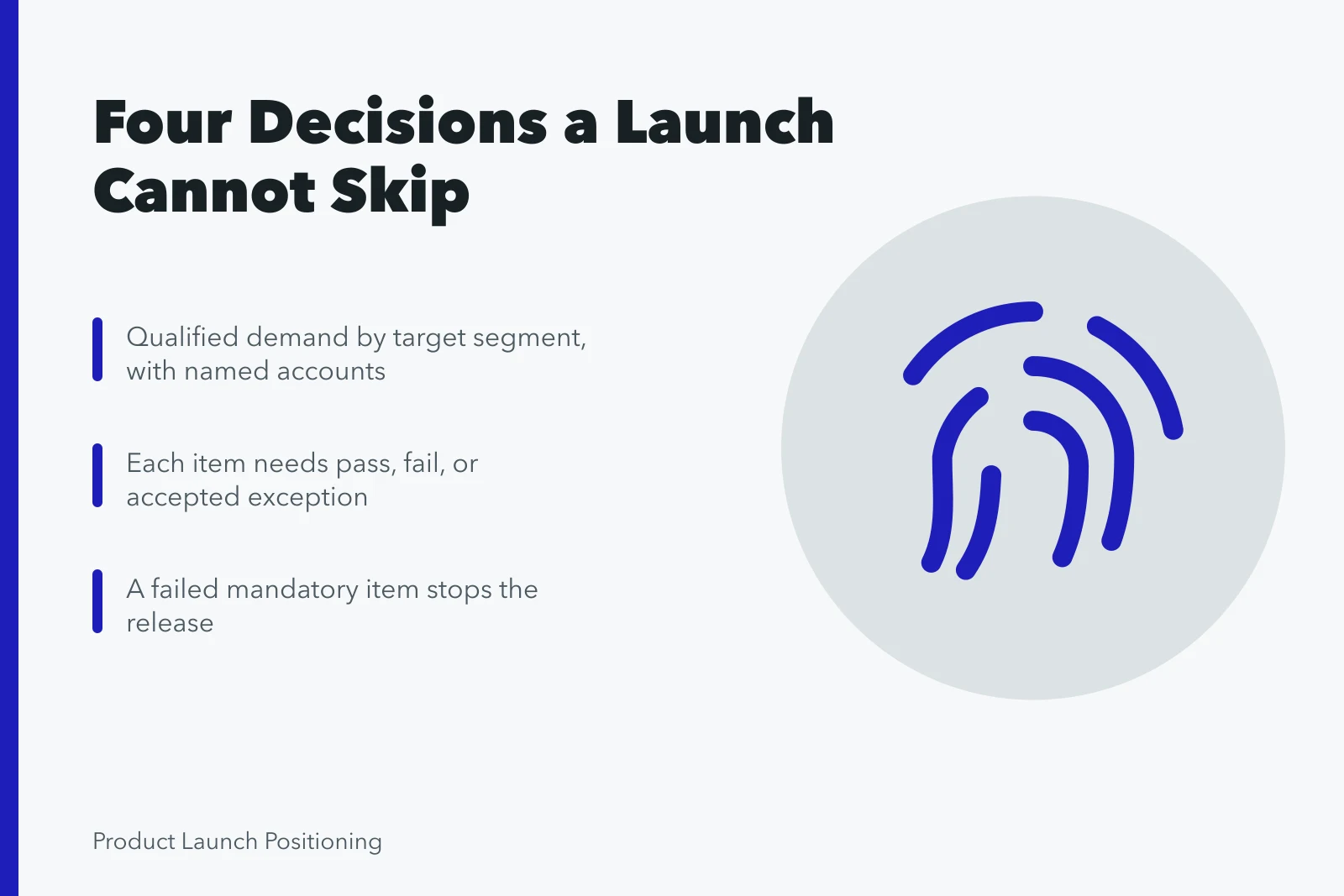
A product marketing strategy checklist earns its keep when it names the four decisions a launch cannot proceed without, and records the evidence behind each.
What to take away
- A checklist that lists review fields instead of decisions gets filled in and ignored.
- The four items below are the ones a launch cannot proceed without: segment, claim, enablement, and adoption measure.
- Each item needs a pass, fail, or accepted exception, plus the evidence and the reviewer's name.
- A failed mandatory item stops the release. It does not become an assumed approval.
- When an item changes, retest it. An old approval does not carry forward.
The four items, in order
Most checklists fail because they ask reviewers to confirm that work happened. That produces a page of initials and no decision. These four items ask a different question: what would have to be true for this launch to proceed, and who checked it.
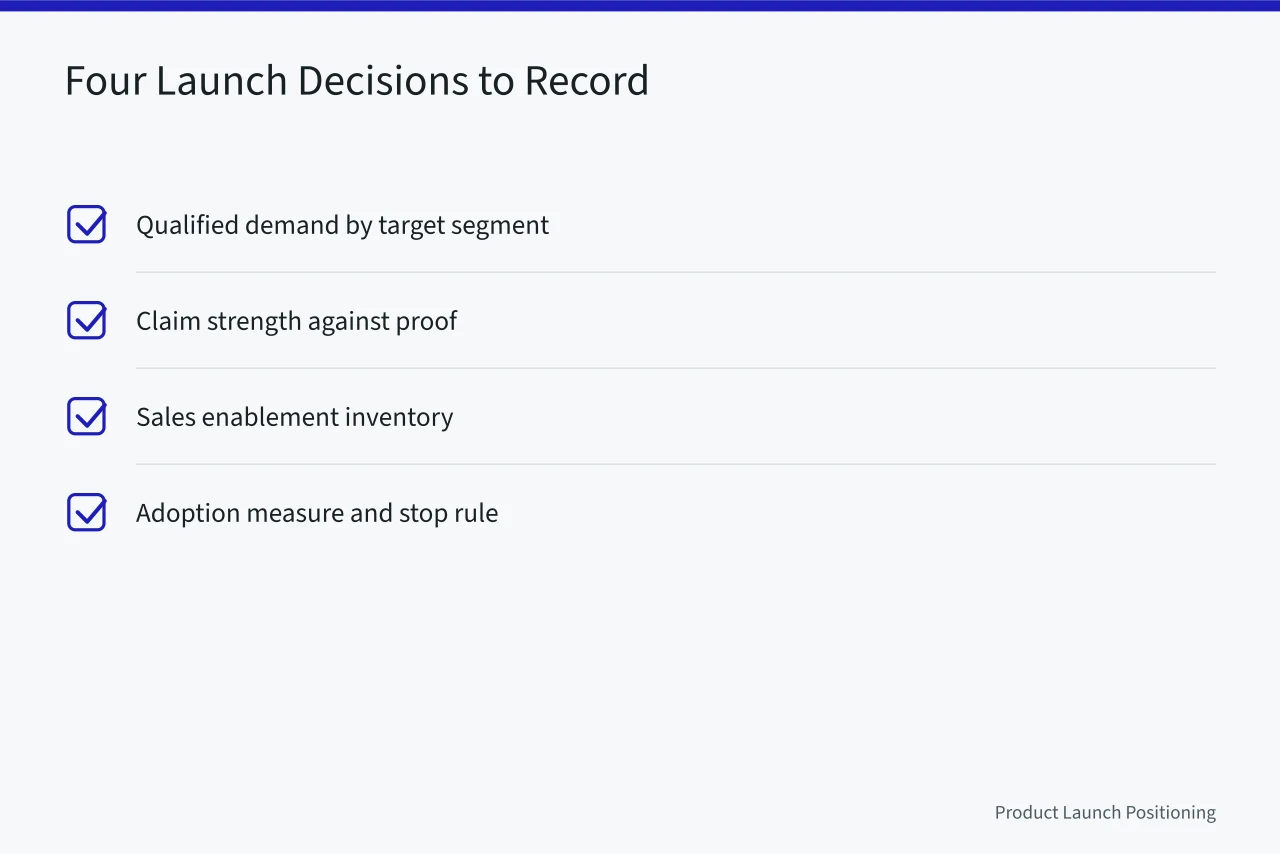
1. Qualified demand by target segment. Name the segment, the problem it has, and the buying trigger. Then state the evidence that demand exists: pilot signups, letters of intent, a waitlist with named accounts.
"Interest is high" is not evidence. The pass condition is a number you set before the launch, drawn from your own pilot data rather than a borrowed benchmark.
2. Claim strength against proof. Write each public claim and the proof behind it on the same line. A claim with no proof is a positioning failure waiting for launch day. Rank claims by how much evidence carries them, and cut the ones that outrun it. This is where marketing and product argue, and the argument is the point.
3. Sales enablement inventory. List the assets a rep needs on day one: objection handling, a demo script, a pricing sheet, a comparison page, a security answer set. Mark each as ready, in draft, or missing. A missing asset is a launch risk, not a marketing backlog item.
4. Adoption measure and stop rule. Define what durable product use looks like for the target segment, how you will read it against cohort data, and the date you will review it. Set the threshold at which you pause expansion. Without this, launch day is the only measurable event and everything after it is opinion.
| Item | Pass condition | Evidence to file |
|---|---|---|
| Qualified demand | Pre-set number of named accounts or pilots | Pilot data, dated |
| Claim strength | Every public claim has proof on the same line | Claim and proof record |
| Enablement | All day-one assets marked ready | Asset inventory, owner named |
| Adoption measure | Threshold and review date agreed | Cohort read, stop rule |
Where the evidence rules come from
The GAO data reliability guide treats data quality as a function of intended use and asks for a documented assessment. That is the right frame for item one: your demand evidence is only as good as the use you are putting it to. The guide supports a reproducible review. It does not certify your dataset.
For any launch that touches personal data, the W3C Privacy Principles statement gives designers shared concepts and warns against pushing privacy work onto individuals. Apply those concepts to the actual data flow, then confirm the governing law with qualified Canadian counsel.
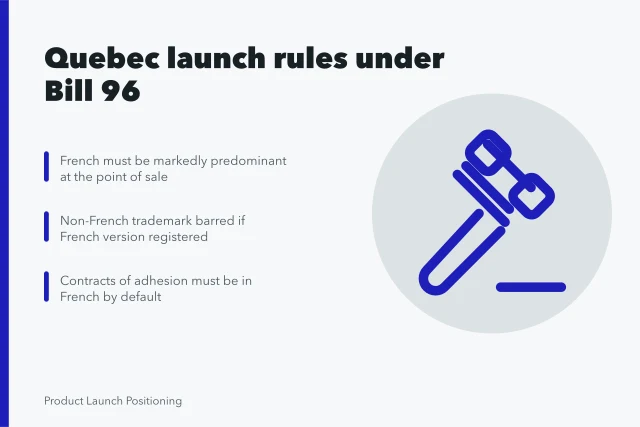
PIPEDA, CASL and Quebec's Bill 96 each set their own requirements, and the NIST Privacy Framework starting guide is a management aid for identifying risk and assigning owners, not legal clearance.
If the product is bought by public sector or enterprise buyers, the CISA software acquisition fact sheet points to development practice, supply-chain exposure, deployment and vulnerability management. Add those to the purchase record for item three. Buyers in Ottawa public sector procurement will ask for them.
An example: case 115
Case 115 is a mid-market software launch where the team had demand evidence and enablement assets but no adoption measure. The launch shipped on schedule. Ninety days later, no one could say whether the target segment was still using the product, because the only tracked event was the signup.
The fix was not a new tool. The team wrote the four items onto one page, set a threshold for durable use, and named a reviewer for each. The next release took two extra days to clear. It also caught a claim that had no proof behind it, which is the cheaper place to find that out.
Common questions
What is the first decision on the checklist?
Define the strategy owner, the target segment, and the outcome you are buying with this launch. The product marketing strategy working file should carry the approved scope, exclusions, version and decision date, so a later reviewer can see what changed and why.
How do you review the checklist without slowing the launch?
Review the four items once, at a fixed gate, with the evidence attached. Items that pass stay passed. Items that change get retested. The gate is slow only the first time, when the evidence does not exist yet.
What should a team avoid?
Avoid activity that is disconnected from product evidence. A launch plan full of tasks that no one can tie to a claim, an asset or a measure will clear the gate and teach the team nothing.