Reviews
Part of Product marketing strategy: the version that survives contact with reality
Product marketing strategy tools: what the good ones share
Product marketing strategy tools differ less in features than in how they force a team to state a market, a claim and a proof. Compare them on that.
What to take away
- Product marketing strategy tools split into five jobscompetitor tracking, roadmap evidence, positioning tests, sales enablement, and adoption analytics.
- Competitive intelligence sits in Klue, Crayon and Kompyte; roadmap evidence in Productboard, Aha! and UserVoice.
- Positioning runs on April Dunford's method, the Positioning Canvas, and Wynter's message tests, which Peep Laja founded.
- Sales enablement lives in Highspot, Seismic and Showpad; adoption and launch readiness in Gainsight and Pendo.
- Price the exit before the entryexport format, seat count, and who owns the data file.
- Run one equal trial per candidate on your own market, claim and proof, then record the edition and date.
Product marketing strategy tools are not one category. They split into competitive intelligence, roadmap and voice-of-customer, positioning and message testing, sales enablement, and adoption analytics. Each answers a different question, and buying two from the same group usually wastes a seat.
The five groups, and who sits in each
Competitive intelligence. Klue, Crayon and Kompyte pull competitor pricing pages, release notes, job ads and win/loss notes into one feed, then push a battlecard to sales. Klue and Crayon sell annual per-seat contracts and quote rather than publish list prices. Kompyte, owned by Semrush since 2021, sits lower for smaller teams and shorter contracts.
Five tool groups compared
Competitive intel
- Example tools
- Klue, Crayon, Kompyte
- Pricing model
- Per seat annual
- Best-fit team
- Named competitor set
- Typical budget
- Tens of thousands a year
Roadmap & VoC
- Example tools
- Productboard, Aha!, UserVoice
- Pricing model
- Per contributor tiered
- Best-fit team
- Product teams
- Typical budget
- Tens of dollars per seat/mo
Positioning
- Example tools
- Dunford, Canvas, Wynter
- Pricing model
- Per test or free
- Best-fit team
- Buyer panel
- Typical budget
- Free or quoted per study
Sales enablement
- Example tools
- Highspot, Seismic, Showpad
- Pricing model
- Per seat enterprise
- Best-fit team
- Sales team 20+ reps
- Typical budget
- Tens of thousands a year
They suit a company with a named competitor set and someone whose job is to keep it current. Budgets for a mid-size team typically land in the tens of thousands of dollars a year, and seat count drives the bill.
Roadmap and voice of customer. Productboard, Aha! and UserVoice link feature requests to accounts and revenue, so a roadmap decision carries evidence. Productboard and Aha! publish tiered plans priced per maker, with entry tiers usually in the tens of dollars per seat per month and higher enterprise quotes. UserVoice leads with request capture and public idea voting.
They suit product teams that must justify what they build. Productboard syncs requests with Jira, Salesforce and Slack, so one item carries the customer quote and the deal size.
Positioning and message testing. April Dunford's method, set out in her book Obviously Awesome, starts from competitive alternatives, then unique attributes, value, best-fit customers and market category. The Positioning Canvas turns the same argument into a one-page template. Wynter, founded by Peep Laja, runs a message test against a recruited panel of your buyer profile.
Wynter is priced per test rather than per seat, and each study is quoted. The canvas methods are free and cost you a workshop instead.
Sales enablement. Highspot, Seismic and Showpad hold the battlecards, decks and objection handling, and report which asset a rep actually opened. All three quote enterprise contracts per seat, on annual terms, with onboarding and support billed separately.
Enterprise contracts here usually start in the tens of thousands of dollars a year and scale with rep count. They suit a sales team above roughly twenty reps.
Adoption and launch readiness. Gainsight and Pendo track whether the buyers you won actually use the product, by cohort. Pendo prices on tracked users and has a free tier for small products; Gainsight quotes per seat, often alongside its customer-success tooling.
They suit anyone whose launch metric is durable use, not signups.
For the strategy these tools serve, see product marketing strategy.
What the good ones have in common
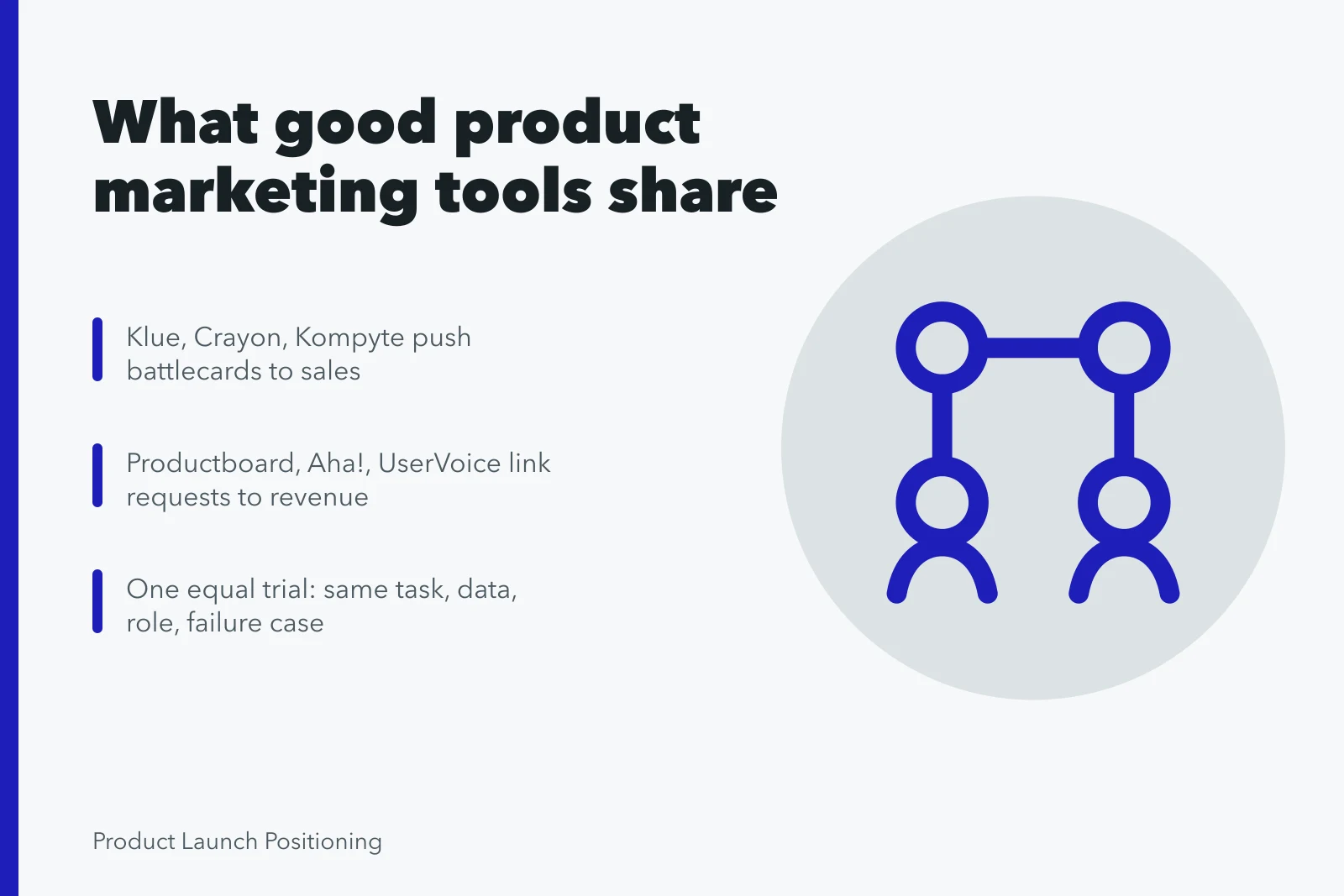
Every tool above does four things: it holds one version of the truth, it shows who changed what, it exports to a format you can keep, and it names the evidence behind a claim. A tool that cannot do all four becomes a second spreadsheet.
Klue, Crayon and Kompyte timestamp a competitor change, so a rep can see how fresh a battlecard is. Productboard, Aha! and UserVoice keep the request, the account and the revenue on the same item. Wynter returns a written claim with the test result that supports it.
The GOV.UK technology selection guidance frames the same test for public buyers: adaptable choices, data control, security review, and attention to ownership cost. Substitute your own buyer and the questions hold.
Security review is part of the purchase record. The CISA software acquisition fact sheet points buyers at development practice, supply-chain exposure, deployment and vulnerability management. Keep its stated scope visible; it is a check, not an approval.
Run one equal trial
Give every candidate the same task, the same data, the same role, and the same failure case. Then price the labor needed to reach an accepted result.
| Review field | What to record | Acceptance test |
|---|---|---|
| Named tool | Product, edition, plan, date quoted | Same edition priced and dated |
| Core task | Market choice, positioning, messaging, launch, adoption | Completed by the intended role |
| Data | Import, definition, export, deletion | Portable, readable record |
| Control | Access, logging, correction, recovery | Observed failure response |
| Behavior | Which asset a rep opened, which cohort used the feature | Change seen in the intended role |
| Cost | Setup, seats, support, change, exit | Owned total-cost estimate |
Design the trial before you run it. The NIST experimental design selection guidance starts from the objective and the practical constraints, and keeps descriptive reporting separate from a controlled effect estimate.
Log the trial. The CISA business-system logging guidance explains why organizations retain and review event records. Keep access, change and correction records without claiming a log proves a business result.
Worked example: case 117
A team of nine compared three competitive-intelligence tools on one competitor set and one quarter of win/loss notes. Two tools produced battlecards sales never opened. The third was slower to set up and showed which card a rep opened before a call.
They bought the third, and cut the two they had been paying for. The deciding detail was which tool changed what a rep did on a Tuesday.
Common questions
What is the first decision when choosing these tools?
Name the market you are choosing to win and the claim you will make in it. A tool that cannot hold that claim, its evidence and its owner is a filing cabinet, not a strategy tool.
How should a team compare them?
One equal trial per candidate: same task, same data, same role, same failure case, then price the labor to reach an accepted result. Record the edition, plan and date, because pricing and features move.
What should a team avoid?
Avoid buying two tools from the same group, and avoid a launch metric that counts signups rather than durable use. If a claim outruns its proof, pull the claim, not the proof.