Costs
Part of Product marketing strategy: the version that survives contact with reality
Product marketing strategy best practices: the discipline behind the results
Product marketing strategy best practices tie positioning claims to product evidence, so launches win qualified demand instead of launch-day noise.
What to take away
- Write the target market, the product promise and the buying process into one product marketing strategy charter before launch work starts.
- Rank every claim by the evidence behind it, and cut the claims you cannot substantiate before the launch date.
- Judge the launch on qualified demand and durable product use, not on impressions or launch-week signups.
- Run win/loss interviews with a fixed script so competitive intelligence stays checkable instead of becoming speculation.
- Set a stop ruleif activity keeps running while product evidence stays flat, pause and correct.
Positioning that survives launch day
A positioning statement is a claim with a market attached. Write it as one sentence: for whom, against what alternative, and why the product wins on a criterion the buyer already uses.
Claim strength ranking
Claim type
- Benchmark
- Strong
- Customer story
- Medium
- Sounds good
- Hope
Strength
- Benchmark
- Show buyer
- Customer story
- Reference check
- Sounds good
- Fails
Launch-day test
- Benchmark
- Customer story
- Sounds good
Rank the claims in that sentence by strength. A claim backed by a benchmark you can show a buyer is strong. A claim backed by a customer story is medium. A claim that only sounds good is not a claim, it is a hope, and launch day is when hopes get tested.
The FTC advertising substantiation policy holds that objective advertising claims need a reasonable basis before you disseminate them. That is a US standard, and it applies to the exact promise, audience and qualification you put in market. Check your own market's rules with counsel.
The buying process decides the launch plan
Map who signs, who uses, who blocks and who pays. In industrial and software sales these are often four different people, and the launch asset that convinces one can lose another.
Then match assets to stages. A technical buyer wants a spec sheet and a reference site. An economic buyer wants payback arithmetic in their own numbers. A user wants a trial that works on their data.
Name the assets you have and the ones you do not. A launch with three strong assets beats one with twelve thin ones.
When activity drifts from product evidence
The common failure is a launch that produces motion: webinars, paid pilots, trade show booths, agency content. None of it changes what buyers believe about the product, because none of it carries product evidence.
Watch for this signal. Pipeline grows, trials start, and activation stalls at the same step every cohort. That gap is a product or onboarding problem wearing a marketing costume.
Set the stop rule before you need it. If two review cycles pass with rising activity and flat activation, pause spend and put the budget into the step where users stall.
Running the review
| Field | What to record | Acceptance test |
|---|---|---|
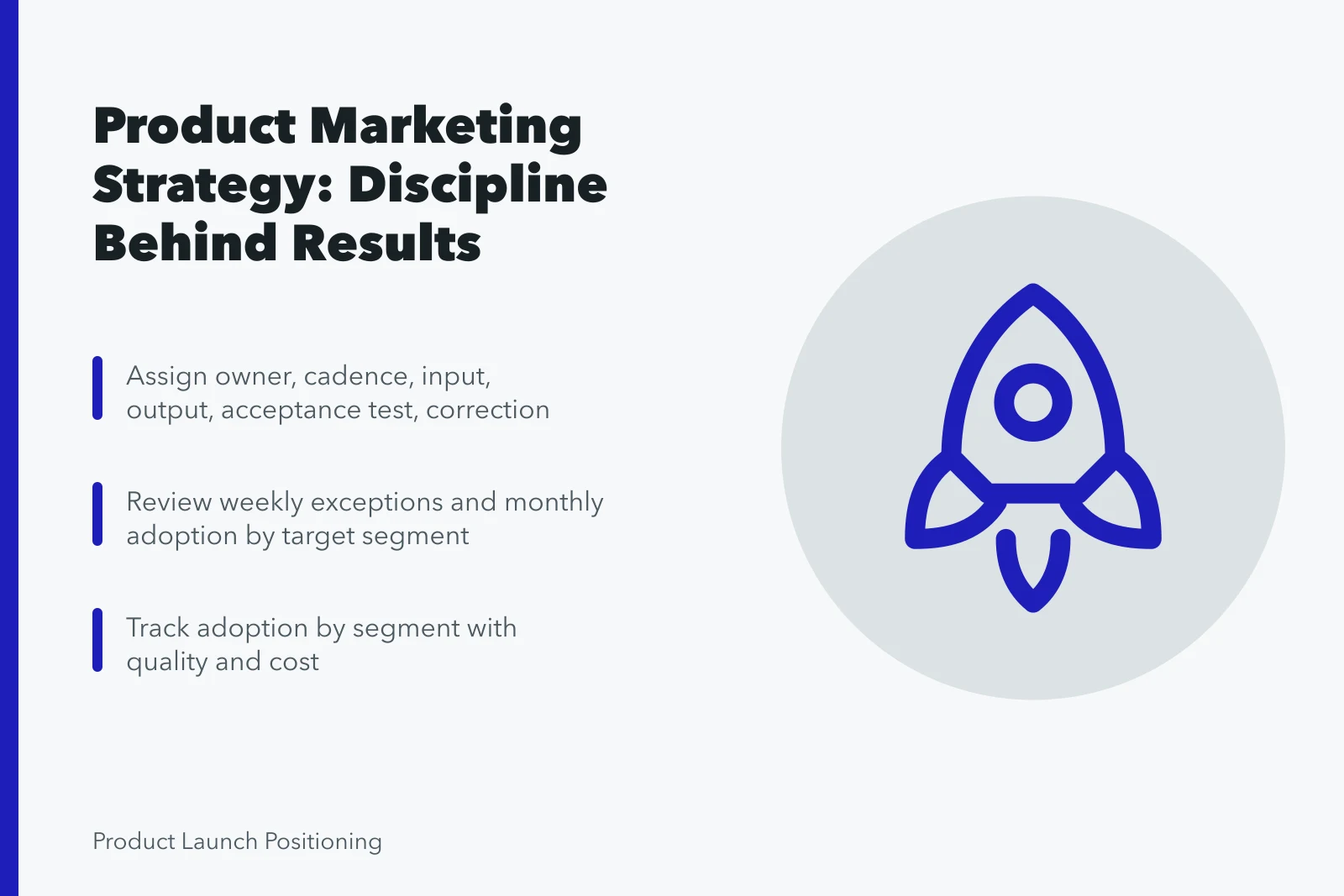
| Weekly | Exceptions and broken handoffs | Named repair owner |
| Monthly | Activation by target segment | Decision with quality notes |
| Quarterly | Claims, evidence, tools, access | Retest or retire |
| Event driven | Activity disconnected from product evidence | Pause, correction, closure |
Test the result before you scale it. Use a defined population, compare against a stated basis, and observe one normal path plus one failure path. Record the version, the inputs and the decision date.
For software purchases, the CISA software acquisition fact sheet points buyers toward development practice, supply-chain exposure, deployment and vulnerability management. Add those checks to the purchase record without treating them as approval.
Two further prompts apply to tooling choices. The GOV.UK technology selection guidance recommends adaptable choices, data control, security review and attention to ownership cost. The GOV.UK open standards guidance links open standards to interoperability, reuse and reduced supplier dependence. Both govern UK public-service work, so treat them as portability prompts, not as decisions for your launch.
A worked check
Take one launch claim and test it end to end.
- Write the claim as a buyer would repeat it.
- List the evidence behind it and date each item.
- Find the segment where the claim matters most.
- Run one pilot and record activation, cost and quality.
- Compare the result with the claim, then keep, qualify or cut it.
If the evidence does not support the claim, the fix belongs in positioning, not in louder promotion.
Common questions
What is the first decision in a product marketing strategy?
Name the target market and the alternative you replace. Everything else follows from that choice. This includes messaging, pricing, launch assets and channel spend. Reversing it later costs the whole campaign.
How do you keep competitive intelligence honest?
Interview wins and losses with a fixed script, record who said what and when, and separate what a buyer told you from what you inferred. Unverified inference about a competitor's roadmap is the usual way these programs drift.
What should a team avoid at launch?
Avoid activity that runs without product evidence behind it. If webinars and paid pilots keep going while activation stays flat, the launch is generating motion, not demand, and the budget belongs at the step where users stall.
How should the launch be reviewed?
Review activation by target segment against cost, quality and exclusions, on a dated record. Expansion should depend on a result you can reproduce with the people, rights, capacity and budget you actually have.