Rules
Part of Product marketing strategy: the version that survives contact with reality
Reading the product marketing strategy case studies for transferable lessons
Audit product marketing strategy case studies by splitting provider claims from measured records and disclosing commercial ties before you transfer anything.
What to take away
- Split every case into four columns before you believe itprovider claim, customer statement, measured record, commercial tie.
- Publish your inclusion and evaluation criteria before you shortlist providers, not after.
- Reproduce one material result on your own data before you transfer the method.
- Treat a case with no disclosed commercial relationship as incomplete, not neutral.
- Keep the audit file dated and versioned, because the decision you defend in a year is the one you wrote down.
A case study is a sales document until you audit it. The audit is the work of separating what a vendor says from what a customer measured.
The four-column evidence split
Most teams read a case study as one block of proof. Read it as four columns instead, because each column carries different weight.
Four-Column Evidence Split
Provider claim
- What belongs
- Vendor wording, edition, date
- How to test
- Ask for data or qualify
- If missing
- Hypothesis only
Customer statement
- What belongs
- Named quote, role, relationship
- How to test
- Check paid, was paid, coached
- If missing
- Unverified relationship
Measured record
- What belongs
- Numbers with population, period
- How to test
- Rebuild arithmetic from inputs
- If missing
- Lead, not evidence
Commercial tie
- What belongs
- Payment, free access, placement
- How to test
- Disclosure beside the claim
- If missing
- Hidden tie invalidates
A provider claim with no measured record behind it is a hypothesis. A measured record with a hidden commercial tie is a lead, not evidence.
The FTC guidance on soliciting and paying for online reviews covers fake feedback, selective requests, conditioned incentives, hidden relationships and paid ranking. Those integrity checks apply to case studies the same way they apply to reviews.
Case 119, worked
Case 119 is a mid-market software launch where the vendor published a 31% lift in trial-to-paid conversion. Run it through the four columns.
Auditing Case 119
- Provider claim31% lift, vendor blog, launch quarter
- Customer statementnamed director, no payment mentioned
- Measured recordno population, control, or trial definition
- Commercial tiecustomer sits on vendor advisory board
- Outcome31% unverifiable as stated
- Transferableonboarding sequence and pricing question change
The audit outcome is that the 31% is unverifiable as stated. The transferable part is narrower: the vendor changed its onboarding sequence and moved a pricing question earlier in the flow. That change is checkable on your own funnel.
Run your own version with named variables. If your baseline conversion is B, your trial volume is V, and your test period is T weeks, then the arithmetic you need is (new rate − B) × V × T. Substitute your own figures. Do not borrow the vendor's.
Inclusion and evaluation criteria, published first
Write the criteria before you contact anyone. A shortlist assembled first and justified afterwards is a shortlist you cannot defend.
Inclusion and evaluation criteria
- State the segment, company size band and launch type you will accept.
- State the evidence you requirepopulation, period, method, named owner.
- State what disqualifies a caseundisclosed payment, anonymous customer, no measured outcome.
- State the date by which a case goes stale and must be rechecked.
Publish those criteria where your team can see them. When a case fails, the failure is visible against a rule, not against taste.
Privacy claims in launch case studies
Launch case studies increasingly lean on privacy as a differentiator. The W3C Privacy Principles give designers shared vocabulary and warn against shifting privacy work onto individuals. Use that vocabulary to read the claim, then check it against your own data flow.
Canadian launches add three instruments. PIPEDA sets the federal baseline for commercial handling of personal information. CASL governs commercial electronic messages, including consent and unsubscribe mechanics.
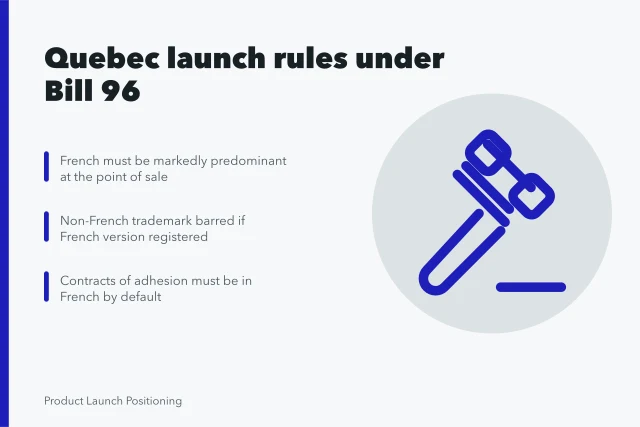
Quebec's Bill 96 adds French-language obligations for businesses operating there. None of these is a marketing claim you can copy from a case study.
Name the instrument, then take the specific question to qualified Canadian counsel.
The GOV.UK guidance on working with open standards links open standards to interoperability, reuse and reduced supplier dependence. It governs UK public-service work, so treat it as a portability prompt and keep its scope visible.
The GOV.UK guidance on choosing technology raises adaptability, data control, security review and ownership cost. Those questions shape a pilot without endorsing a supplier.
What the audit file holds
Keep one file per case, versioned, with the four columns and the criteria version it was judged against. Record the reviewer, the date, the unresolved limits and the stop rule.
Expansion should follow a result you can reproduce with your own people, rights, capacity, systems and budget. Early indicators are diagnostic, not proof. State which conditions are still unknown.
The product marketing strategy page covers how market choice, positioning and measurement fit together once a case clears the audit.
Common questions
What makes a case study auditable?
A stated population, a period, a method and a named owner on the customer side. Without those four, you have a claim, not a record.
How do I handle a case with a hidden commercial tie?
Mark it as a lead, not evidence, and note the tie beside the claim. If the tie cannot be confirmed either way, treat the case as incomplete.
Can I transfer a vendor's result to my own launch?
Only after you reproduce the mechanism on your own data. The mechanism is often transferable; the percentage almost never is.
When should a case study be retired?
When the launch it describes is more than one product cycle old, or when the vendor cannot restate the method. Set the date when you file it.