Rules
Product Launch Positioning: A Pre-Launch Test Before You Commit
A pre-launch test for product launch positioning: run buyer calls and sales role-plays, score proof gaps, then rewrite or delay before spending on launch.
What to take away
- A pre-launch positioning test uses real buyer calls and sales role-plays, not a survey or a workshop vote.
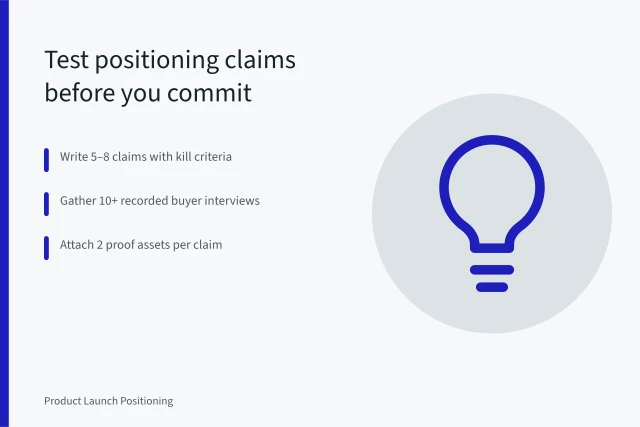
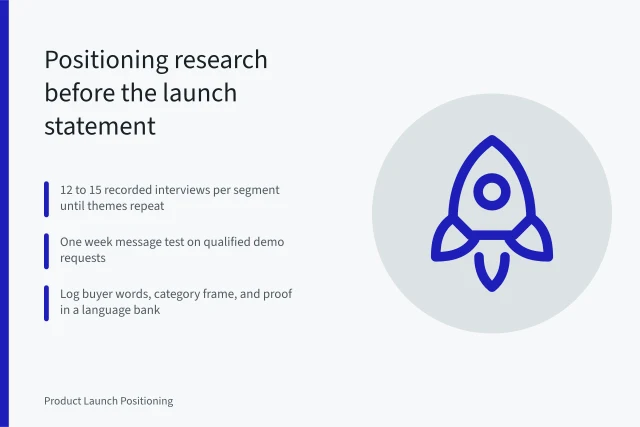
- Run the test with five target buyers and two sales reps over two weeks before you fund launch assets.
- Score the transcripts for repeated claims, proof gaps and price objections; a failed score means rewrite or delay.
- Use a pass or fail checklist to decide whether the positioning statement moves to messaging and campaign work.
Why a pre-launch positioning test matters
Teams often write a positioning statement in a workshop and then move straight to messaging. The missing step is validation with real buyers and sales conversations. The general framework on product positioning explains target, category and difference but stops before proof.
A positioning statement test asks whether a buyer repeats the core claim in their own words. It also asks whether a sales rep can defend the claim without a slide deck. If either fails, the statement is not ready for launch.
This test sits between strategy and execution. It connects the written plan to the actual launch loop. Without it, teams spend on assets for a claim that buyers do not accept.
The three-part pre-launch test
- Draft one positioning statement of 25 words or fewer. Include the target buyer, the problem, the product category and the main difference.
- Recruit five buyers who match the target segment and two sales reps who will carry the launch.
- Run one 20-minute buyer call and one 15-minute sales role-play for each participant.
- Transcribe the first sentence each buyer uses to describe the product after hearing the statement.
Before the calls, review competitor claims and category assumptions with SBA market research guidance. This step sets a realistic timeline and avoids a claim that the market already rejects.
A checklist for scoring the transcripts
- Buyer repeats the core claim without prompting.
- Buyer names the problem before the product category.
- Sales rep states proof for the claim in under 30 seconds.
- Objection about price or a competitor appears in at least two calls.
- No buyer asks what the product actually does.
Score each item as pass or fail across all calls. A single fail on the first two lines is a warning. Two or more fails across the set means the statement needs a rewrite before any launch spend.
Example: a failed positioning claim in a buyer call
Buyer: "So it helps teams plan work, but I already use a spreadsheet for that. Why would I switch?"
In that transcript, the buyer did not hear the difference. The statement used a category the buyer already owned. The sales rep could not give proof because the claim was too broad. This failure is cheap to find before launch and expensive to fix after.
Reading risk signals before launch
| Risk signal | What it means | Action |
|---|---|---|
| Buyer repeats a generic category word | The difference is not clear | Rewrite the claim with a specific outcome |
| Sales rep adds a new claim | The statement lacks proof | Add a proof point or remove the claim |
| Price objection appears in every call | The value story is weak | Test a new value metric |
| No buyer asks about features | The problem is not urgent | Revisit the target segment |
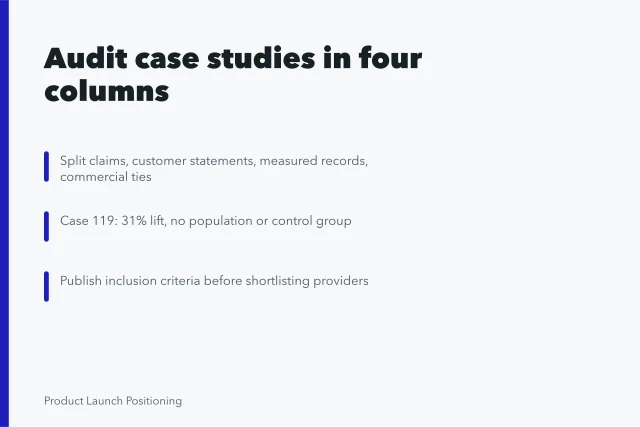
Before you finalize proof points, read the FTC advertising and marketing guidance. It reminds teams that claims need evidence before a campaign runs.
Write the buyer problem, product choice, pricing model and delivery limit before launch day, as covered in Go-to-market strategy in practice. That written plan gives the test a baseline.
The same claims must match proof and sales handoffs under load, a theme in product marketing strategy that survives reality. The test protects both pages of work from a claim that buyers reject.