Rules
Product launch positioning research: the evidence to gather before you commit
Research methods, interview questions, and a checklist for testing product launch positioning claims before you commit copy, budget, or dates.
What to take away
- Treat every positioning claim as a hypothesis with a written kill criterion.
- Gather evidence from buyer interviews, recorded sales calls, and support tickets.
- Attach one proof asset to each surviving claim, because sales and buyers ask for the same thing.
- Check permits, labels, and advertising rules early, since they can move a launch date.
- Start this work four to eight weeks out and finish before launch copy is written.
Write the claims before you book interviews
Positioning research stalls when the brief stays vague. Write five to eight claims as plain sentences, each with a subject, a benefit, and a buying group. The practical detail is set out in The recurring questions behind every product.
"Warehouse managers cut pick time by a fifth" can be tested. "We are the modern choice" cannot. The second one describes your mood, not a buyer outcome.
Keep every claim short enough to read aloud in thirty seconds. If a claim needs three clauses, it is two claims wearing one coat.
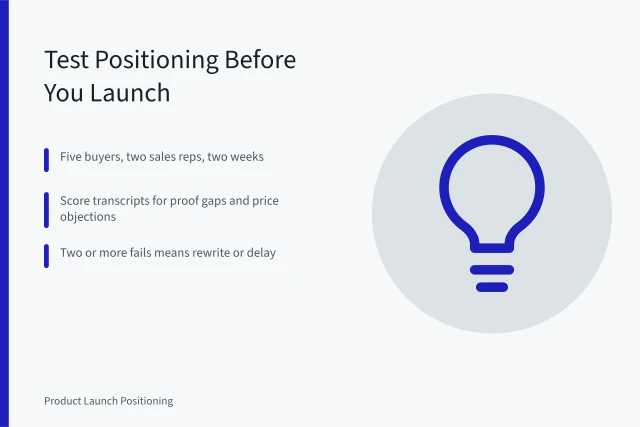
Give each claim a kill criterion. Decide upfront what evidence would retire it, then hunt for that evidence directly.
Positioning research methods ranked by yield
Different methods produce different quality of evidence. A recorded buying conversation usually beats a survey of strangers.
Use interviews for buyer language, sales calls for objections, support tickets for friction, and competitor teardowns for contrast. The Small Business Administration guide to market research and competitive analysis sets a reasonable frame for the early phase.
- List the claims and the decision each claim would change.
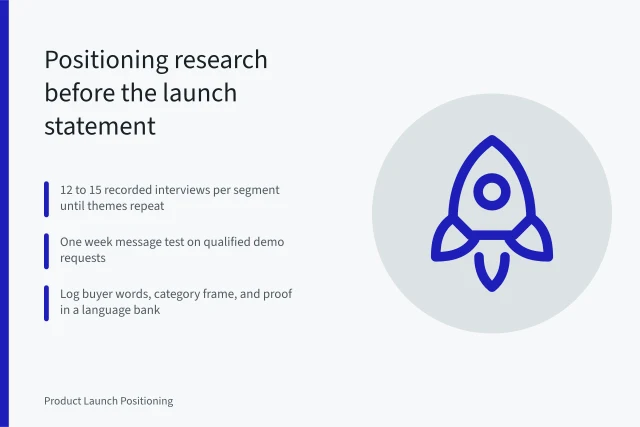
- Recruit eight to fifteen people who match the buying group, not your contact list.
- Record and transcribe the calls, then tag each sentence to a claim.
- Rank claims by how often buyers raised the idea unprompted.
- Retire or rework claims that nobody volunteered.
Unprompted repetition is the strongest signal available before launch. A phrase buyers raise before you mention it belongs in the headline, not an appendix.
Customer interview questions for positioning validation
Ask about past behavior rather than future intentions. Questions about what someone already did produce facts you can quote.
- Walk me through the last time this problem cost you money.
- What did you try first, and what did that cost?
- Who else had to approve the purchase?
- What nearly stopped you from buying?
- How would you describe this problem to a colleague?
Leading questions repeat your own wording back at the buyer. You then hear your words echoed and mistake that for agreement.
The general concepts behind product positioning describe how buyers sort options into categories. Interviews show which category your product actually lands in.
Positioning evidence checklist before you commit
- Ten or more recorded interviews from the target buying group.
- Two named proof assets, such as a test report or a reference customer.
- Objection list pulled from the last twenty sales calls.
- Competitor claims compared line by line with yours.
- Labeling and permit requirements confirmed in writing.
A claim without a proof asset becomes a promise sales must keep without tools. Trim the message until every claim on the slide has something behind it.
Every positioning claim should survive one question from a skeptical buyer.
Example: one claim tested against twelve calls
A kitchen equipment maker planned to lead with a labor cost claim. Twelve interviews mentioned labor cost twice and uneven browning nine times.
The team moved the labor figure to a supporting slide and added a batch test video. The headline changed. The manufacturing schedule did not.
That is what this research buys: better words before the expensive decisions are locked. It also settles the launch timeline planning argument, because the message stops changing weekly.
Where regulatory evidence fits
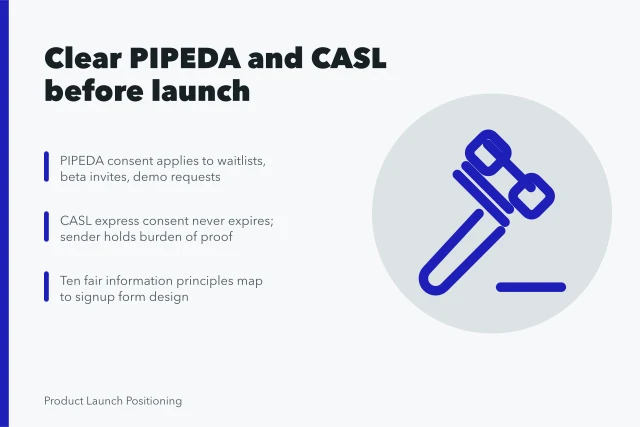
Permits, labels, and advertising rules decide what you may claim, not only what you may sell. A performance claim needs substantiation before it ships.
The Federal Trade Commission advertising and marketing guidance explains the substantiation standard for consumer products. Read it before copy review, not after.
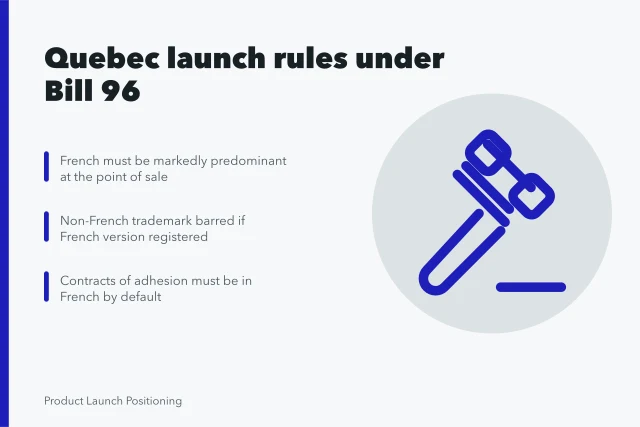
Bilingual packaging rules in some Canadian markets change design deadlines. Permit fees and translation work belong in your product launch costs model, not in a contingency line.
From evidence to a launch decision
Score each claim as supported, thin, or unsupported. The unsupported ones leave the launch deck, even when a founder likes them.
Most common launch failures trace back to a message that no buyer recognized. A short, supported claim list is easier to defend in a sales meeting.
The result feeds a product marketing strategy that holds up after launch. Write the questions to ask before committing on one page and answer them with the evidence you gathered.