Operations
Part of Go-to-market strategy in practice, not on slides
Which go-to-market strategy questions business teams ask most, in plain terms
The questions business teams ask most before a launch, what each question actually decides, and the customer evidence that answers it without guesswork.
What to take away
- Seven decisions sit behind most pre-launch questionsthe buyer, the problem, the price, the channel, the proof, the capacity and the date.
- Every answer needs a named owner, a dated evidence period, and the single exception that would change it.
- The launch date is an output. Set it after the buyer and capacity answers hold.
- Law, tax, safety and contract questions belong to counsel, a CPA or the relevant regulator, not the launch team.
The seven questions business teams ask most
Scope note: this covers launches into the United States market. Canada appears only where a rule genuinely differs.
Most launch teams work from a short list of common product marketing strategy questions, answered here one decision at a time. The wording shifts by industry, but the decision behind each question does not.
Seven go-to-market questions
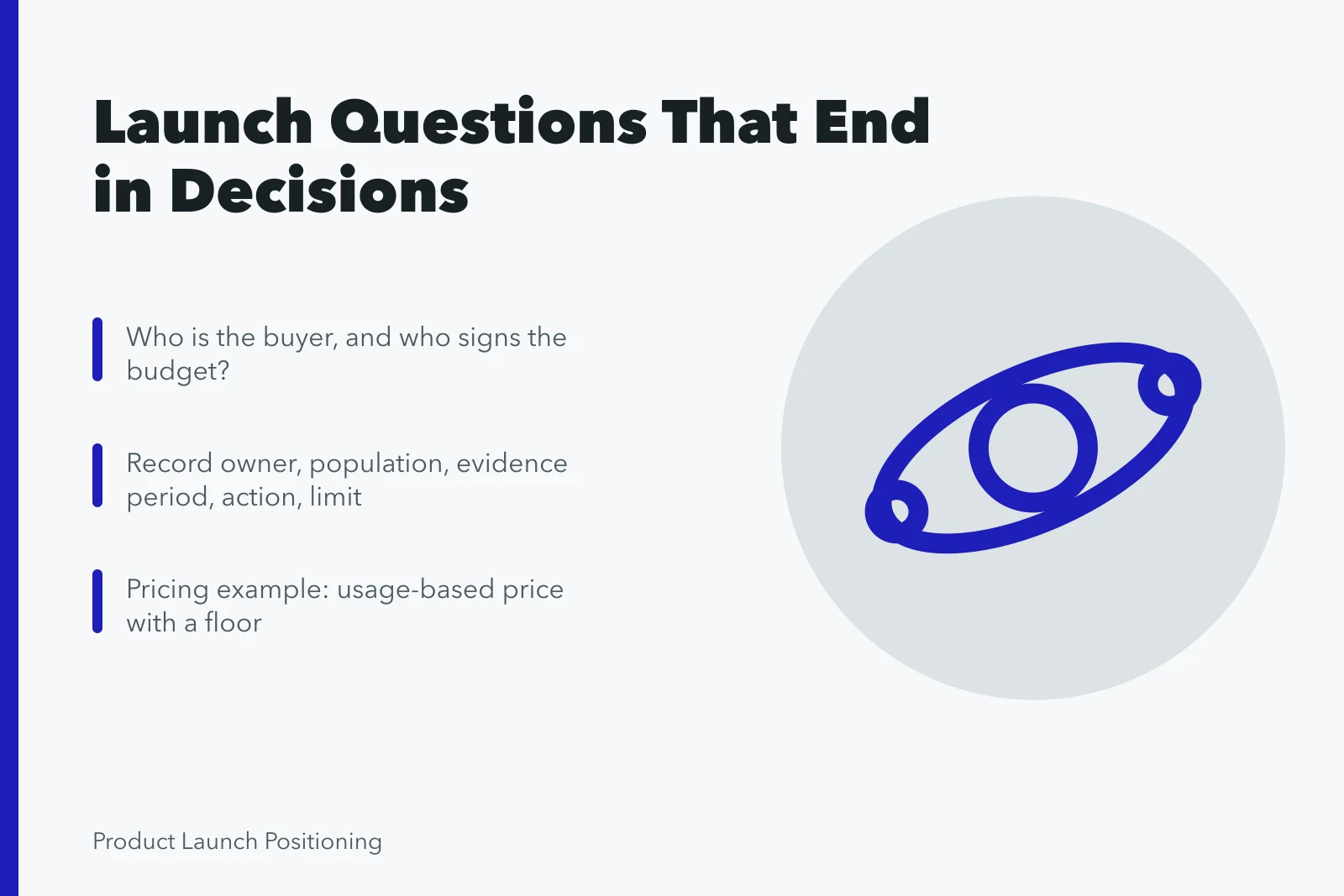
- Who is the buyer, and who signs?
- What problem does this replace?
- What do we charge, and on what model?
- Which channel reaches them first?
- What proof do we have, and who says it?
- Can we deliver and support it?
The seven questions
- Who is the buyer, and who signs? The user and the budget holder are often different people. Someone still marks the economic buyer in the CRM.
- What does this replace, and what does the buyer use today? The product competes with the current workaround, including doing nothing. Jobs to Be Done interviews and win/loss calls in Gong show that workaround.
- What do we charge, and on what model? Seat, usage, subscription or a one-time capital purchase, each with a different sales motion. Van Westendorp and Gabor-Granger surveys return a range, not proof of willingness to pay.
- Which channel reaches them first? Direct sales, distribution, a marketplace listing or a systems integrator. A distributor such as Ingram Micro, or a marketplace such as AWS Marketplace, changes sales motion and margin.
- What proof do we have, and who will say it out loud? A reference customer or a pilot result carries more weight than a claim. A named reference beats a logo on AppExchange.
- Can we deliver and support it at the volume we promise? Industrial and software launches fail quietly here. Product analytics from Pendo or Mixpanel, plus tagged support tickets, show whether the team can hold the promise.
- When do we launch, and what has to be true first? The date follows from the six answers above. MEDDICC qualification marks the buyer, metrics and decision criteria before anyone sets one.
A launch date set before the buyer and capacity questions are answered is a guess wearing a calendar.
Answer each question on a market-entry decision record
A market-entry decision record is one page per question. It names the owner and the population the answer covers. It also names the evidence period, the method, the action and the limit.
Market-entry decision record
| Field | What to record | Acceptance test |
|---|---|---|
| Decision | Which question the page answers | Named owner and due date |
| Population | Who the answer covers, and who it excludes | Eligibility written down |
| Evidence | Source, date and sample behind the answer | Dated and checkable |
| Action | What the team does next | Owner and deadline |
| Limit | What would change the answer | Review trigger named |
Market-entry decision record fields
- Decisionquestion, named owner, due date
- Populationwho is covered and excluded
- Evidencesource, date, sample
- Actionwhat the team does next
- Limitwhat would change the answer
The record earns its keep when a launch slips. A reader can open it six months later and judge whether the answer was wrong or the market moved. The four items a product marketing strategy checklist has to cover overlap with these fields, which is why one page per question stays short.
Example: the pricing question for a Midwest manufacturer
A team selling a monitoring device to mid-size manufacturers asks what to charge. The record reads: decision, the price model for the first 50 units.
Population: Ohio and Michigan plants with 100 to 400 staff. Evidence: twelve win/loss interviews and two paid pilots. Action: usage-based pricing with a floor. Limit: a competitor bundle through the buyer's existing supplier changes the answer.
The page holds no revenue forecast and no claim about what the market will bear. Those numbers come from the team's own pilot data.
Where the evidence comes from and where it stops
Win/loss interviews, pilot data and tagged support tickets answer the buyer and capacity questions. The SBA guidance on market research and competitive analysis treats that work as a phase with its own timeline, not a one-off document.
Competitive claims need the same discipline, and competitive intelligence drifts into speculation fast when the sources carry no dates. Keep the win/loss file and the competitor file apart.
Date every source. An undated note is an anecdote with a job title attached. A later reader cannot tell whether it described the market or one loud customer.
Then there are the questions that leave the room. California's CCPA and CPRA, CAN-SPAM, the federal research credit under IRC Section 41 and state sales tax nexus after South Dakota v. Wayfair each belong to counsel or a CPA.
For consumer products, FTC advertising and marketing guidance sets what a claim must support before it runs. Product safety sits with the CPSC business education resources, a separate checklist from the marketing one.
Canada-specific note: teams selling into Quebec also check Bill 96 language rules, while PIPEDA and CASL govern personal data and commercial email.
Keep the specialists on a named list with dates. The notes on go-to-market strategy in practice explain how to stop that list from stalling the launch calendar.