Careers
Part of Product marketing strategy: the version that survives contact with reality
The product marketing strategy trends that will still matter next year, 2027 edition
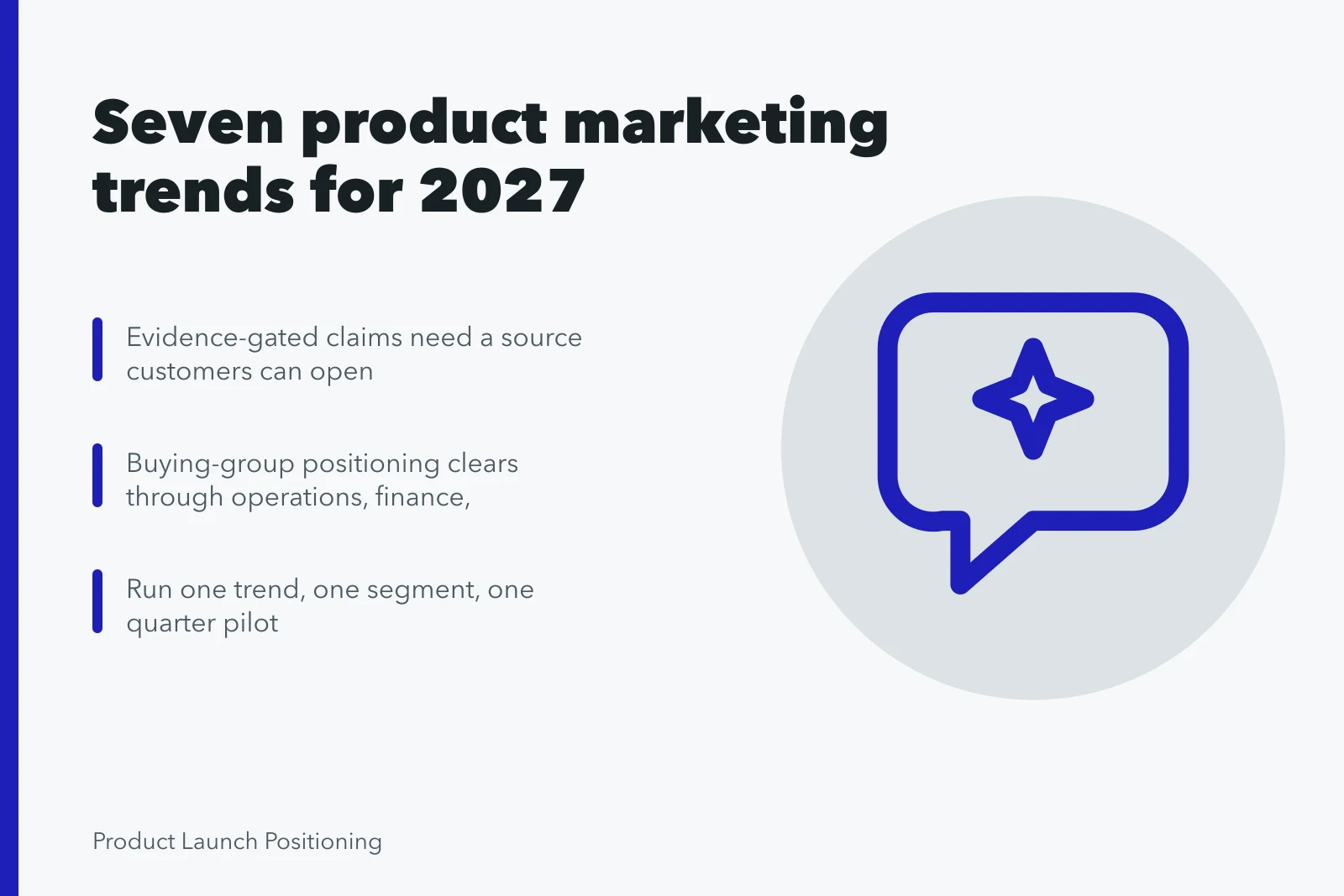
Seven product marketing strategy trends for 2027, each with the evidence to check and the pilot that decides whether it earns a place in your plan.
What to take away
- Seven trends carry weight into 2027. Evidence-gated claims, buying-group positioning and segment-level adoption lead the group.
- The other fouragent-readable product pages, proof-led sales enablement, competitive intelligence discipline, and procurement-ready trust files.
- Each trend needs an owner, a primary source and a pilot before it enters the plan.
- Adoption is read by target segment against cost and quality, never as one blended number.
- A trend earns budget only when a test on your own accounts reproduces the result.
- Write the product marketing strategy charter before the pilot, so a failed test changes the plan instead of the story.
Seven trends worth planning around in 2027
Evidence-gated claims. Buyers check messaging against documentation, so every claim needs a source a customer can open. The NIST Privacy Framework starting guide shows the pattern: name the risk, assign an owner, record the response. It is a management aid, not legal clearance for a claim.
Two live drivers: the FTC's Health Products Compliance Guidance expects competent and reliable evidence behind health claims, and the EU AI Act's Article 50 transparency duties for AI-generated content apply from August 2, 2026.
Buying-group positioning. Industrial and software deals now clear through a committee of operations, finance, security and the end user. Gartner's B2B buying research puts typical purchase groups at six to ten stakeholders, so positioning written for one reader stalls in review. Write one page per role, each answering that role's blocking question.
Segment-level adoption. Blended adoption hides which cohort actually stuck. Report adoption by target segment with cost and quality beside it, and treat early spikes as diagnostic only. Cohort views in Amplitude, Mixpanel, PostHog and Google Analytics 4 split retention by signup week, plan tier or industry.
Agent-readable product pages. Buyers and their tools parse spec tables, unit lists and compatibility notes before a sales call. A page that buries the operating range in prose gets skipped. Publish schema.org Product markup with price, availability and GTIN, and set robots.txt rules for GPTBot, Google-Extended and PerplexityBot.
Proof-led sales enablement. Asset inventories are being pruned to what a rep can defend live. Keep the reference call, the pilot result and the integration note; retire the rest. Repositories such as Highspot, Seismic and Showpad tag assets by deal stage, which shows the items reps open before a call.
Competitive intelligence discipline. Programs drift into speculation when nobody dates a claim. Every competitor entry needs a source, a date and a disconfirming signal to watch. Klue, Crayon and Kompyte store that record beside the battlecard, so a stale claim surfaces before a rep repeats it.
Procurement-ready trust files. Buyers now ask for development practice, supply-chain exposure and vulnerability handling before a pilot. The CISA software acquisition fact sheet lists those checks. Add them to the purchase record; they are not an approval.
Expect a software bill of materials in SPDX or CycloneDX format, NIST SP 800-218 development practices, and the EU Cyber Resilience Act's main obligations from December 11, 2027.
Run the pilot before the plan
Pick one trend and one segment. Write the objective and the practical constraint first, because the NIST experimental design selection guidance starts design choice there, not with the tool.
Then decide what you are measuring. Descriptive reporting tells you what happened. A controlled comparison tells you whether your change caused it. Most teams need the second and run the first.
Set the arithmetic in your own figures: incremental qualified demand equals pilot-segment adoption times average deal value, minus program cost. Substitute your numbers; no benchmark replaces them.
Set a stop rule and a review date before launch. If the result does not reproduce with your current people, rights, capacity and budget, the trend stays on the watchlist.
Keep the strategy boundary visible
The strategy working file holds the approved scope, exclusions, version, owner and decision date. Customer problem, product promise, target market and buying process stay on one page. Delivery capacity and commercial evidence sit beside them.
The W3C Privacy Principles give designers shared privacy concepts and warn against pushing privacy work onto individuals. Apply them to the actual data flow, then check the governing law and consent with qualified counsel. PIPEDA, CASL and Quebec's Bill 96 each set their own requirements; a marketing team cannot settle them alone.
A worked review
| Field | Test | Record |
|---|---|---|
| Case | One trend, one segment, one quarter | Population, date, reviewer |
| Method | Confirm the primary source, effective date, eligible users and reversal condition | Inputs, observations, open limits |
| Outcome | Compare against qualified demand and durable use | Adoption by segment, plus cost and quality |
| Escalation | Stop if activity is disconnected from product evidence | Correction owner, next review |
Common questions
What is the first decision?
Name the trend owner, the target segment and the outcome, then write the charter and the evidence that would stop the work. A trend without a stop condition becomes a permanent line item.
How should a trend be reviewed?
Review adoption by target segment with cost, quality, exclusions and failures beside it. Date the decision record so the next reader knows which source version it rests on.
What should a team avoid?
Avoid activity disconnected from product evidence, and avoid treating a vendor announcement as adoption. When an error reaches a public page, correct it there and note the fix.