Strategy
Part of Go-to-market strategy in practice, not on slides
Go-to-market strategy examples: built into a repeatable transfer test
Go-to-market strategy examples from Figma, Slack, Zoom and others, plus a transfer test that shows which parts of each playbook fit your market.
What to take away
- Eight plays appear below, each with its own triggerfile caps at Figma, history and app limits at Slack, a call timer at Zoom, a record cap at Airtable and free seats at Atlassian.
- Notion, Calendly and Dropbox spread through a template gallery, a public booking link and paid referrals.
- The mechanism and its trigger point transfer. The numbers belong to the source company.
- None of the eight publishes conversion or seat-growth figures. Treat quoted growth as unverified.
- A transfer test needs two buyer groups, one conversion moment and a dated stop rule.
Eight plays, one test each
Each row names a mechanism and the question that decides fit. Every entry is a go-to-market strategy in the ordinary sense, a defined route to a buyer, as described in the overview of go-to-market strategy. Sources are the companies' own pricing and documentation pages. Limits move, so re-check before quoting one.
| Company | Mechanism | Transfer test |
|---|---|---|
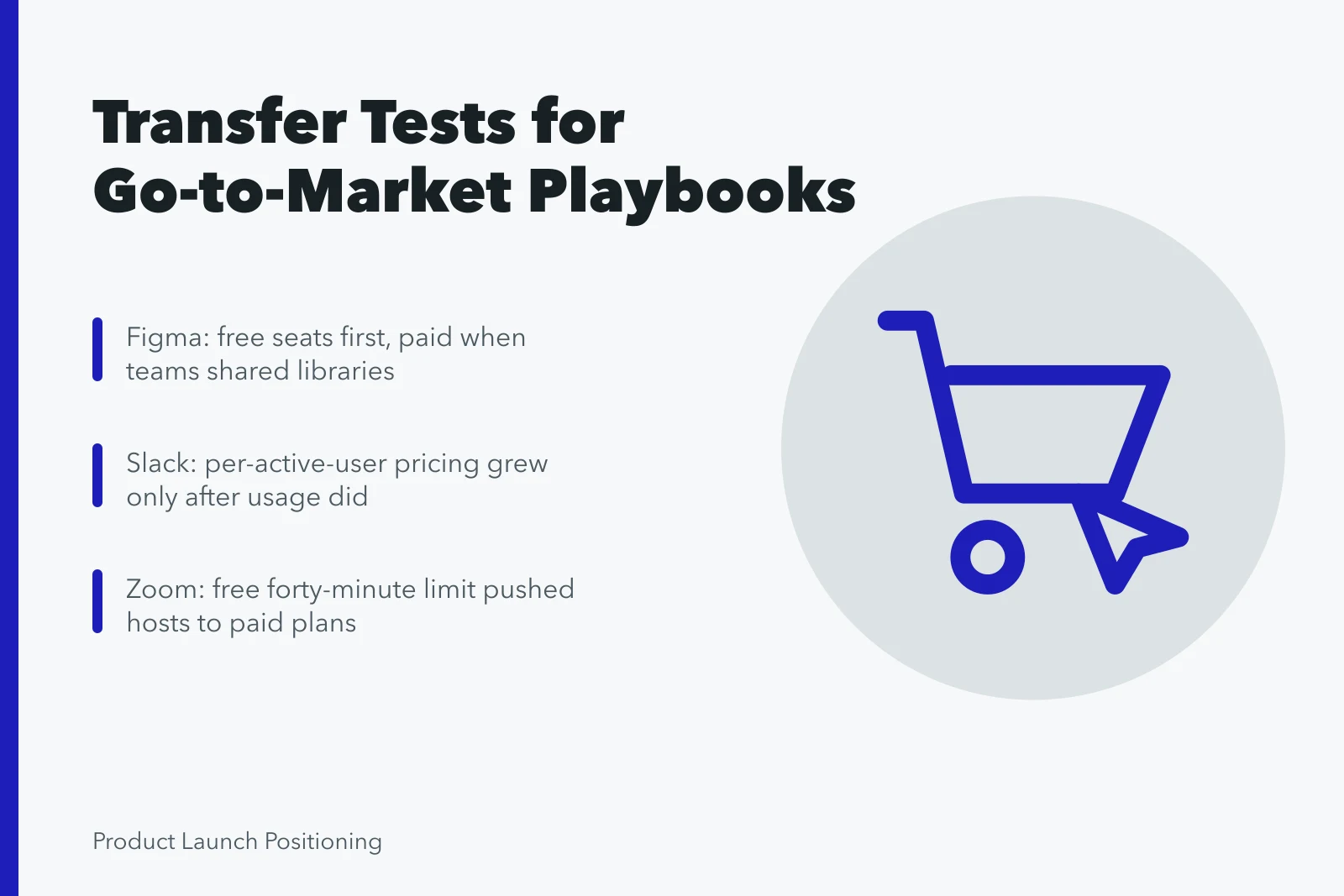
| Figma | Free seats; paid when shared libraries and version history are needed | Does your free tier cap an asset a second person needs? |
| Slack | Free plan keeps 90 days of history and 10 installed apps | Does history or integration depth make a team pay? |
| Zoom | Free group calls cut at 40 minutes and 100 attendees | Does your product create its own time trigger? |
| Notion | Public template galleries act as the demo | Can a stranger use the product before talking to sales? |
| Airtable | Free bases cap at 1,000 records | Does a data ceiling arrive during normal use? |
| Calendly | A free booking link spreads through signatures and invites | Does each use expose the tool to a new organization? |
| Atlassian | Jira and Confluence free up to 10 users | Does headcount, not a feature, trigger the upgrade? |
| Dropbox | 2 GB free plus a referral bonus for both sides | Does the reward relieve a limit the user already feels? |
Four questions settle transfer: who buys, what triggers the upgrade, what capacity the play needs, and what evidence would stop it.
Transfer test questions
- What was the starting condition?
- What mechanism produced the result?
- What did the company already have?
- What evidence would show failure here?
No public conversion figure exists for any of the eight. These companies publish pricing and release notes, not the internal numbers that would settle an argument. Say that on your own slides rather than borrowing a statistic you cannot source. The product marketing strategy examples collection sets each company's wording beside its mechanism.
Picking which play fits
Start with the trigger, not the brand. With no storage ceiling, Dropbox's referral bonus has nothing to relieve. With a security review before installation, Figma's free seats stall.
Segment contrast is the second filter. Run one offer past two defined groups and hold the offer steady. A gap between groups is signal. A gap inside your own pitch is noise. The SBA guide to market research and competitive analysis lists the evidence to gather before choosing a channel.
Example: Figma's file cap on a 12-person team
Assume a 12-person product team, three of them designers. The figures below are illustrative, not Figma's terms.
Figma's file cap
- Write the mechanism in one sentencedesigners adopt free, and the team pays when a shared asset becomes necessary.
- Replace the cap with your own ceiling. If the free tier allowed three shared files, your test ceiling might be three live projects.
- Hold the offer steady across two buyer groups, such as in-house teams and agencies.
- Define the conversion moment and the cost per activation. Record who upgraded and what they needed first.
- Set a stop rule and a review date. Miss the threshold and the test ends.
That staging, rather than a single launch day, is the case argued in go-to-market strategy development.
Three ways a copied play fails
- Wrong buyer. A 25-person software team copied Figma's bottom-up motion but sold to buyers who run a security review before any seat activates. Six weeks produced no activations. Illustrative figures.
- Wrong trigger. A second team copied Dropbox's 2 GB free allowance and a 500 MB referral bonus. Their product had no storage pressure, so nobody invited anyone.
Both failures share one cause. The copied number was never the point. The trigger was, and it was missing.
- Unsupported claim. A rumored competitor price change reaches a sales deck with no source behind it. The FTC's policy statement on advertising substantiation requires a reasonable basis for objective claims before you publish them.
Sourced competitor files are the fix, and the competitive intelligence article covers what belongs in one.
Checks before you commit budget
- Name the mechanism, not the company
- Write your starting condition in one sentence
- List what the source company had and you do not
- Set a conversion moment, a cost per activation and a dated stop rule
- Confirm every public claim has a documented basis
Keep the first test small enough to end early. A pilot that cannot be stopped is not a test.