Rules
Part of Go-to-market strategy in practice, not on slides
Developing a go-to-market strategy in controlled, testable stages
Staged go-to-market strategy development pairs named owners with finish conditions, substantiation files, and a timed failure-path run before launch.
What to take away
- Name one owner per stagediscovery, definition, approval, production, release, measurement, correction.
- Write a finish condition each stage can be tested against, not a description of activity.
- Hold the claim file to the FTC advertising substantiation standard before any public message ships.
- Run the workflow twiceonce clean, once with a missing input, and time both.
- Record the stop rule and the review date beside the decision, not in a separate document.
Stages need finish conditions, not job titles
A stage is done when the next role can use what it receives without asking a question. "Brief sent" fails that test. "Brief accepted by the release owner, dated, with scope and exclusions listed" passes it.
Stage Owners and Finish Conditions
- Discoveryproblem statement, named buyer, evidence date
- Definitiondated brief with promise and exclusions
- Approvalclaim file signed against standard
- Productionassets versioned, rights cleared
- Releasego or no-go with stop rule
- Measurementconversion, cost, quality logged
- Correctionerror traced to source and repaired
Assign one owner per stage. Shared ownership means the handoff stalls at the first disagreement.
| Stage | Owner | Finish condition |
|---|---|---|
| Discovery | Market researcher | Problem statement with named buyer and evidence date |
| Definition | Product marketer | Dated brief: promise, audience, exclusions |
| Approval | Legal or compliance reviewer | Claim file signed against substantiation standard |
| Production | Content lead | Assets versioned, rights cleared |
| Release | Launch manager | Go or no-go recorded with the stop rule |
| Measurement | Analytics owner | Conversion by handoff, cost, and quality logged |
| Correction | Support lead | Error traced to source and repaired |
Substantiate the claim before the market sees it
The FTC advertising substantiation policy holds that objective claims need a reasonable basis at the time they run. Build that file during definition, not after a complaint.
For each claim, record the exact wording, the audience, the test or source behind it, and the qualification that limits it. A claim with no qualification and no test is a launch-day liability.
Where the product touches personal data, the W3C Privacy Principles statement gives designers shared concepts and warns against pushing privacy work onto individuals. Apply that to the actual data flow, then confirm the governing law with counsel.
Test the workflow before you scale it
Run case 122 inside the launch scope. Time one clean pass from intake to accepted output. Then repeat it with one input deliberately missing and record which role catches the break and how long the repair takes.
Compare the two runs against conversion through each handoff, plus cost and quality. Early numbers are diagnostic, not proof of a repeatable route from offer to qualified customer.
If the product is software, the CISA software acquisition fact sheet points buyers toward development practice, supply-chain exposure, deployment and vulnerability management. Add those to the purchase record as checks, not as approval.
For tooling choices, the GOV.UK technology selection guidance asks for adaptable choices, data control, security review and attention to ownership cost. Those questions shape a trial without endorsing a vendor.
Stop rules and the correction route
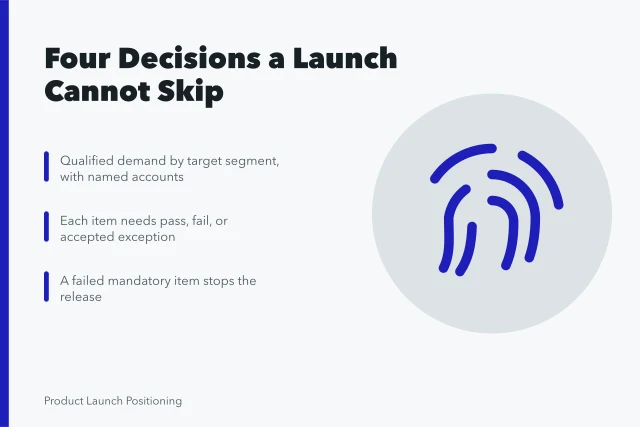
Stop the launch if the failure-path run exposes scaling ahead of sales and service capacity. Write that threshold down before the run, so the decision is not a judgment call under pressure.
When an error reaches a customer, trace it to the stage that produced it, repair the public output, and log the correction against the owner. A correction with no owner repeats.
Close the cycle with a dated decision record: what shipped, what was excluded, which sources were used and when, and the next review date. That record is the input to the next go-to-market strategy revision.
Pair it with the positioning work in product marketing strategy development so the promise and the evidence stay in one file.
Common questions
Who owns the go-to-market brief?
One named person, usually the product marketer, owns the brief from definition through release. They do not own the claim file; a legal or compliance reviewer signs that separately.
What goes in the claim file?
The exact claim wording, the audience it reaches, the test or source behind it, and the qualification that limits it. Objective claims need a reasonable basis before they run.
How long should the failure-path run take?
Time the clean pass first, then the broken pass. The gap between them is your repair cost. If the gap is large, the handoff is the problem, not the person.
When should the launch stop?
When the failure run shows scaling ahead of sales and service capacity. Set that threshold before the run and record who calls it.