Reviews
Part of Go-to-market strategy in practice, not on slides
Go-to-market strategy mistakes, and how correction actually happens
Go-to-market strategy mistakes rarely announce themselves, so teams need a way to trace each defect back to its source before scaling spend further.
What to take away
- Most launch failures come down to four defectsdefinition drift, claim gap, handoff break and false success. Name the defect before you fix anything.
- Trace each defect back to its source, then forward to every asset, deck, report and public statement it touched.
- Keep the prior version. A correction without the earlier value cannot be verified, reversed or defended.
- Give detection, correction and closure different owners, so nobody audits their own handoff.
- Set the stop rule before the review starts, so scaling pauses on a trigger rather than on an argument.
The four recurring mistakes and the fix for each
Most launches fail on one of four defects, and each needs a different correction. Treating a handoff break as a claim gap burns a month and closes nothing.
The four recurring mistakes
| Defect | Symptom you can see | Fix | Acceptance test |
|---|---|---|---|
| Definition drift | The unit or population changed mid-program | Restore the versioned definition, with a date and an owner | Every number compared on one definition |
| Claim gap | The promise outruns the evidence | Correct every asset that carried the claim | The claim matches a citable source |
| Handoff break | A role or finish condition is missing | Assign one owner and retest the path | The owner confirms the finish condition |
| False success | A proxy improved, the outcome did not | Pair each proxy with an outcome measure | Both read in the same report |
Four recurring launch defects
Defect
- Definition drift
- Unit changes mid-program
- Claim gap
- Promise outruns evidence
- Handoff break
- Role or finish missing
- False success
- Proxy up, outcome flat
Symptom
- Definition drift
- Versioned definition, date, owner
- Claim gap
- Correct every affected asset
- Handoff break
- One owner, retest path
- False success
- Pair proxy with outcome
Fix
- Definition drift
- Claim gap
- Handoff break
- False success
Definition drift is the most common. Sales counts a qualified meeting, marketing counts a form fill, and the dashboard adds both. The fix is a definition carrying a version, a date and an owner, restored before any comparison.
Claim gap means the promise ran past the evidence. A page says onboarding time halved because one pilot customer said so. Correct every asset that carried the claim, not only the flagged page. Check the FTC guidance on soliciting and paying for online reviews before a testimonial or ranking claim goes back up.
False success is the quiet one. Demo requests rise while closed revenue stays flat. Pair every proxy with an outcome measure and read them together. That is where spotting product marketing strategy mistakes before they cost money earns its place, because the defect shows long before the report does.
Trace the defect back, then forward
The visible error usually sits downstream of its cause. Run two passes and record both.
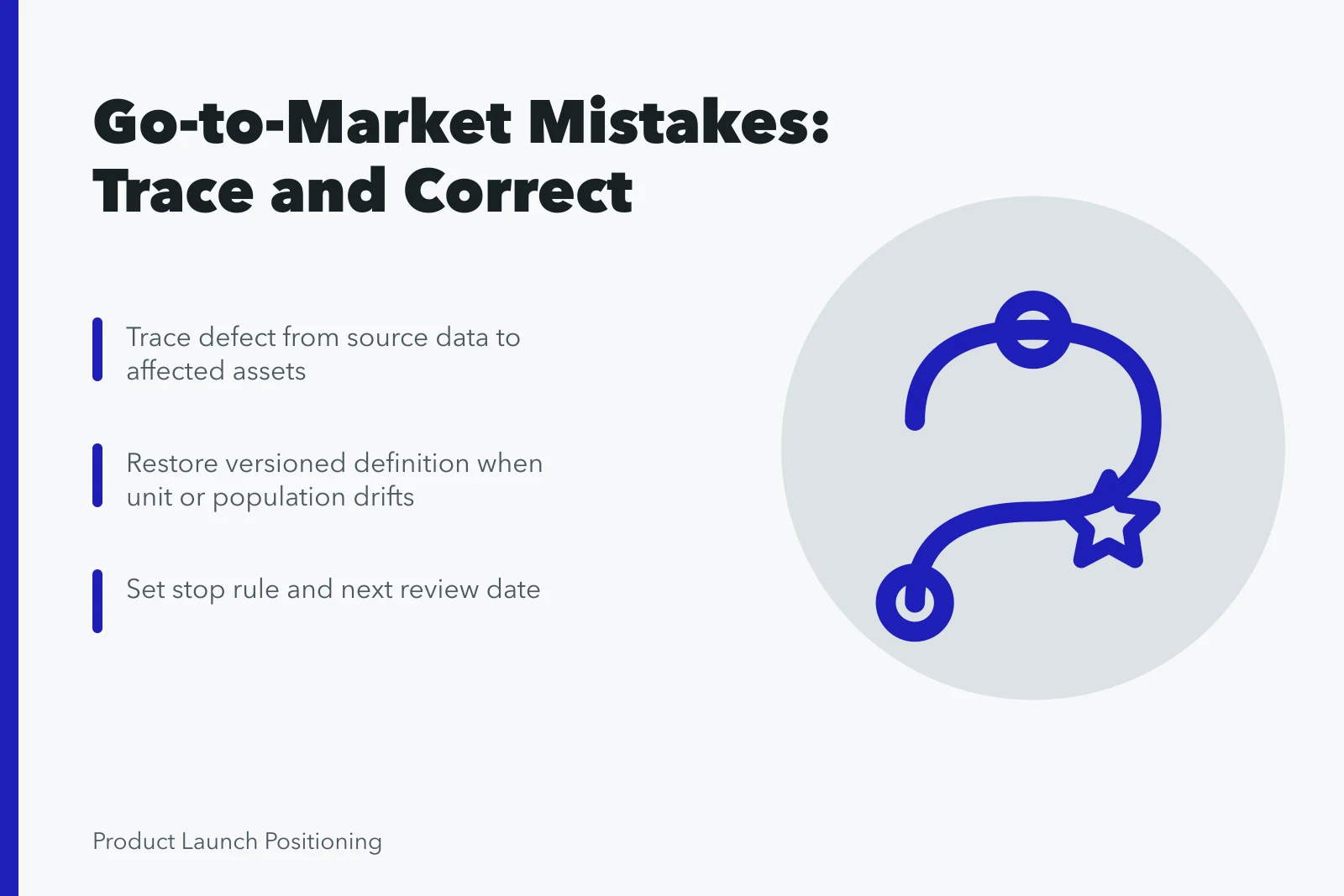
Trace the defect
- Freeze the asset and note its version and date.
- Follow the number back through the definition, the source system and the approving role.
- Follow it forward through decks, pages, partner listings, reports and public statements.
- Record who saw the wrong number and which decision they made with it.
- Preserve the prior version before anything is edited.
Trace failure and correction
- Trace source data, definitions, approvals
- Trace assets, handoffs, reports, decisions
- Preserve the prior version
- Note who was affected
- Record acceptance test per defect
The GAO data reliability guide ties data quality to intended use and asks for a documented assessment. That supports a reproducible review. It does not certify your dataset, so keep its stated scope in the file.
A trace holds only when the plan behind it names owners and finish conditions, which is what a go-to-market strategy in practice, not on slides sets up before launch rather than after.
Example: a composite launch correction, defect to retest
This is a composite illustration, not a named client. A mid-market software launch reported a 41 percent lift in qualified pipeline. The number was arithmetic. Three weeks earlier the "qualified" definition had changed and the prior version was never preserved.
The correction ran in four moves.
Composite launch correction
- Defect nameddefinition drift, scoped to one metric and one date.
- Owner assignedrevenue operations, with the review file dated and signed.
- Assets fixedthe live dashboard, the board deck, two sales pages and a partner listing were restated on the original definition.
- Retest resultthe restated lift came in far lower, and the next monthly read held there.
A corrected figure typically moves double digits against the original, often in the 10 to 30 percent range. Treat that as a typical range, not a target. Product marketing strategy benchmarks, one decision at a time shows how to read a restated number without over-correcting.
Keep scope, owners and evidence visible
Keep one working file for the review. It holds the customer problem and the product promise, plus the target market and the buying process. Record the version and the owner at the top, with the decision date. Commercial evidence sits beside the claim it supports.
The review only holds together when every handoff has a named owner and a finish condition. The launch sequence itself is well documented, and the SBA guide to launching a business covers the ordering and typical timelines, so the review can focus on what went wrong.
When to pause spend or stop
When to pause spend
- Pause when the restated number falls below the level that justified the spend.
- Pause if sales or service capacity cannot absorb current volume.
- Stop if the claim cannot be supported and the asset is already public.
- Resume only after a retest on a fixed date, with a named owner.
A correction without the prior value cannot be verified, reversed or defended.
The escalation row is the one teams skip. If the review shows the pipeline number was inflated, the honest next step is usually to pause spend rather than defend the figure. The go-to-market strategy questions business teams ask most covers the capacity and timing calls that decide whether scaling restarts.