Costs
Part of Go-to-market strategy in practice, not on slides
A go-to-market strategy checklist tied to sign-off points, not intuition
A go-to-market checklist works when every line carries a pass, fail or exception, a named reviewer and a date, and blanks block the release.
What to take away
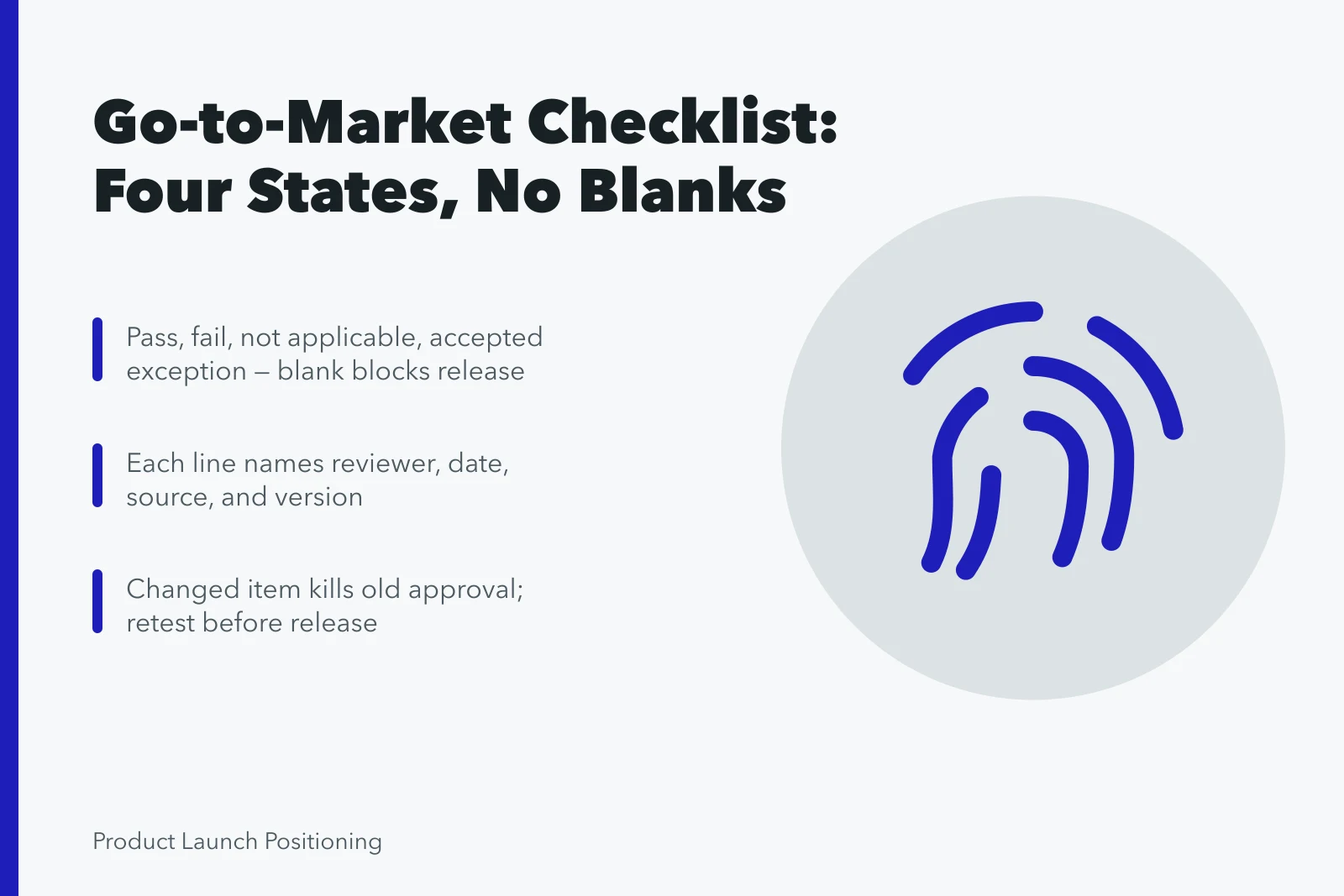
- Every checklist line carries one of four statespass, fail, not applicable, or accepted exception. A blank line is a stop, not a yes.
- Each line names a reviewer, a date, the source behind the answer, and the version it applies to.
- When an item changes, its old approval dies with it. Retest the changed item before release.
- A failed mandatory line blocks release. Record who owns the correction and when it comes back.
- Store the finished checklist beside the released version, so the next audit reads the same file the launch team signed.
A go-to-market checklist is only as good as the evidence sitting behind each tick. The product marketing strategy checklist covers what belongs on the list. This article covers how a team signs it off, and what happens when a line cannot be signed.
The four states, and why blank is not one of them
Most launch reviews fail quietly. Someone leaves a field empty, the meeting moves on, and the empty field reads as approval by the time the build ships.
Four states, blank blocks
Line state?
Pass -> evidence exists, reviewer checked
Fail -> no evidence, line blocks
Then add the fields that make a state checkable:
The four states
- reviewer
- date
- source
- affected version
- correction owner
- next trigger
| Field | What goes in it | What counts as done |
|---|
Four rows that block release
- Scopeaudience, purpose, exclusions, outcome
- Evidenceclaim, method, date, limits
- Operationcapacity, access, support, recovery
- Reviewmeasure, complaint path, stop rule, review date
A blank in any of those four rows stops the release. That single rule removes the most common failure in launch governance, which is a checklist that looks complete because nobody wrote "no" in it.
Where the external checks fit
Procurement and security reviews run on their own clocks, and launch teams often treat them as someone else's problem until the week before ship. Two public documents are worth folding into the purchase record.
The CISA software acquisition fact sheet sets out what buyers should ask about development practice, supply-chain exposure, deployment and vulnerability handling. Add those questions to the checklist as evidence items. They inform the decision; they do not make it.
The GAO evaluation design guide links evaluation questions to the evidence needed to answer them. That discipline transfers to a commercial launch: decide what you are trying to learn, then decide what would count as an answer. The guide was written for federal programs, so keep its context visible and avoid causal claims your own method cannot support.
Retesting after a change
An approval is tied to a version, not to a product. Change the pricing page, the data flow, or the support rota, and the old sign-off no longer describes what ships.
So the checklist needs a change rule. Name the items that must be retested when a given input moves. Pricing changes retest the claim and evidence rows. A new data flow retests privacy and access. A capacity cut retests the operation row.
The W3C Privacy Principles describe shared privacy concepts for system designers and warn against pushing privacy work onto individuals. Apply that to the actual data flow, then confirm the governing law and consent position with qualified counsel. The W3C statement sets a design expectation; it does not decide your legal question.
Accessibility follows the same pattern. The W3C guidance on information and relationships holds that visual structure should also be available programmatically. Test the real page, form, table or report rather than the mockup, and keep the stated scope of that guidance visible before you apply it to the go-to-market strategy as a whole.
Worked example: one line, four states
Take a single line, "support capacity confirmed for launch volume."
One line, four states
- Pass:the support lead attaches a dated staffing plan and a queue model, names the assumptions, and signs.
- Fail:the plan exists but assumes weekend cover that is not funded. The line blocks release.
- Not applicable:the launch is invite-only with no public support channel. The head of support writes that reason and signs.
- Accepted exception:cover is short for the first two weeks. The exception names who carries the risk, what the stop rule is, and when the line is reviewed again.
The value is not in the tick. It is in the sentence that explains the tick, because that sentence is what a new hire reads six months later.
Common questions
Who signs a go-to-market checklist?
The person who owns the outcome, not the person who filled in the form. Each line names its own reviewer, and the launch owner signs the completed document against a version number.
What happens when a mandatory line fails?
Release stops. Record the failure, the correction owner, and the date the line comes back for review. Shipping with a known failure is a decision, so it needs a named decision-maker and a written reason.
How long does a completed checklist stay valid?
Until something it describes changes. Tie validity to the version, not to a calendar date, and retest the affected lines whenever pricing, data flow, capacity or claims move.